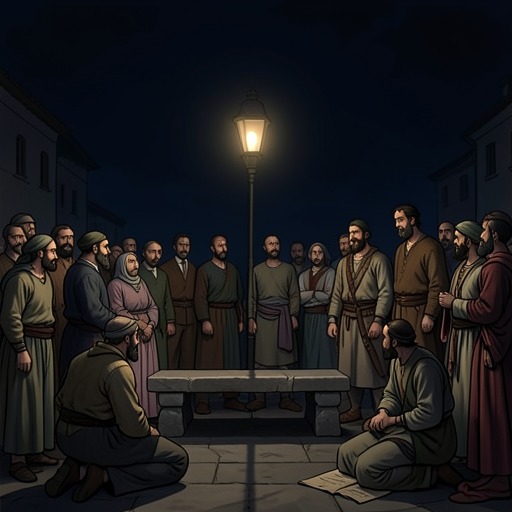
Jerusalem Jewish council
Acts of the ApostlesThe Jerusalem Jewish council is convened to determine the charges against Paul, but the hearing becomes a contest over procedure, authority, and resurrection rather than a fair examination of the case. In Luke’s telling, the council’s failure to hear Paul impartially stands in sharp contrast to the leadership tradition that authorizes his witness; the book also warns that this hostile portrayal is polemical and must not be allowed to reinforce anti-Judaism or antisemitism.
Role and institutional setting
The tribune orders the council to convene to establish what charges stand against Paul, in a hearing compared by the book to a grand jury. The council is thus expected to investigate and judge, exercising a public leadership role within Jewish life. Its conduct in the scene, however, is depicted as inept and divided, and as violating the very principles by which such a hearing should proceed.
That institutional criticism belongs to a larger contrast in Acts between forms of leadership. The apostles serve as an authoritative body for the church and help authorize significant developments in its witness. In Luke’s structural parallel, the council is supposed to perform a function in Judaism comparable to that of the apostles in the community moving toward the Realm. Rather than sustaining that responsibility, the council becomes a site of dissension, with Paul’s would-be killers acting under its aegis. The contrast directs attention not only to individual leaders but to the responsibilities and failures of institutions.
The hearing and its breakdown
Paul begins by asserting that he has lived with a clear conscience. The book explains this as a claim to have remained faithful to God’s purpose as he understood it, both when he persecuted the movement and later when he preached. The high priest responds by ordering those nearby to strike Paul, rejecting his claim before witnesses have been heard. Paul answers by invoking the image of a whitewashed wall: a structure made weak beneath a clean exterior, whose defects are exposed when tested. He applies that image to a council whose high priest presumes Paul guilty without first hearing evidence.
When bystanders accuse Paul of insulting the high priest, Paul says he did not know the speaker was the high priest and cites the scriptural prohibition against speaking evil of a ruler. The exchange complicates the council’s accusation: although Paul has challenged the high priest, the book presents him as recognizing Jewish precedent, while the council has already departed from proper procedure by treating him as guilty before hearing witnesses. The conflict is therefore not simply between Paul and a Jewish institution; it also concerns which party in the scene is acting consistently with Jewish law.
Paul then notices that both Pharisees and Sadducees are present. Identifying himself as a Pharisee on trial over the hope of resurrection, he shifts the hearing onto a theological division between the groups. The Sadducees do not accept end-time theology and resurrection of the dead, and the issue provokes dissension. Some Pharisees defend Paul, saying they find nothing wrong with him and allowing that a spirit or angel may have spoken to him. Their response leaves the final direct reference to the Pharisees in Acts on a favorable note, rather than treating them as a single hostile bloc.
Conflict, protection, and narrative outcome
The disagreement becomes so violent that the tribune fears Paul will be torn apart by the crowd. He removes Paul from the council and keeps him in protective custody. That intervention prevents the hearing from ending in the violence the tribune anticipates, but it does not resolve the underlying conflict over Paul’s testimony or the council’s conduct.
Afterward, the risen Jesus stands near Paul and encourages him, telling him that he will bear witness in Rome. The scene’s ending thus redirects the focus from the failed hearing to the continuation of Paul’s mission: the council cannot settle or silence the testimony, and Paul’s eventual witness in Rome is affirmed beyond its authority.
Luke’s polemic and its limits
The account is not presented as a neutral portrait of the council. The book explicitly warns that Luke’s polemical intent must be made clear to readers, because allowing the scene’s negative characterization to stand without qualification can reinforce anti-Judaism and antisemitism. Its depiction of the council should therefore be read as a narrated judgment within a conflict, not treated as an accurate, comprehensive picture of Jewish councils or Jewish people.
The book also frames the scene through a parallel with the selection of the apostles in Luke. The apostles help maintain the identity and witness of the community moving toward the Realm; Paul’s mission is represented as operating under the aegis of that apostolic tradition. The council, by contrast, is shown in disorder and in violation of legal procedure. This contrast invites scrutiny of leadership: institutions may claim authority while failing the principles that ought to govern them, and the narrative asks readers to distinguish between leadership that sustains a community’s witness and leadership that obstructs it. That critique applies to the church as well as to the council, but it cannot justify turning Luke’s polemic into a general indictment of Judaism.